Retail Performance at Scale
Luxury Has Built Its Stores. The Next Era Is About What Happens Inside Them



For two decades, the luxury industry’s growth story was a story of expansion. New markets, new flagships, new doors in new cities. Boutique counts became proxies for ambition, and the global luxury footprint reached a scale that would have been unimaginable a generation ago. That work has been remarkable; the networks that exist today are the foundation of everything that comes next.
What is changing is not the value of those networks. It is where their next growth will come from.
The most consequential opportunity in luxury today is no longer the boutique waiting to be opened. It is the difference between what existing boutiques achieve and what they are capable of achieving. Across a global network, that difference, compounded across hundreds of boutiques, dozens of markets, and thousands of client interactions, is the largest unclaimed asset on luxury’s unwritten balance sheet. Recovering it is the defining commercial opportunity of the next decade.
At CXG, we call it Retail Performance at Scale.
The New Paradigm
The Growth Model Is Evolving
That infrastructure has now been built. The strategic geographies are mapped. The flagship locations are claimed. And the customer behaviours that once made retail expansion the most reliable growth lever have evolved. Younger luxury customers research before they enter, compare across borders, and treat the boutique as a moment of confirmation rather than first discovery. In key luxury hubs, traffic is no longer expanding in ways that make growth automatic; brands must extract more value from the traffic they already have. The economics of opening additional doors no longer mirror the economics of a decade ago.
This is not a story of decline. Physical retail remains, fundamentally, where luxury is sold. It is a story of maturation. The way value is created in retail has moved upstream: from how many boutiques a brand operates to how each of those boutiques performs. The next phase of growth is already inside the network. It is a matter of seeing it, prioritizing it, and recovering it.
Customer Experience, Matured
Two Disciplines, One Agenda
Customer experience as a discipline has long since earned its place at the luxury table, and the body of work it has produced is foundational. The mapping of journeys, the measurement of perception, the deep understanding of what customers expect from a luxury Maison and where those expectations are met or missed; none of that work is being replaced. It is being built upon.
What is changing is the connection between customer experience and commercial performance. For much of the past decade, the two operated in parallel. Customer experience teams produced satisfaction scores, journey diagnostics, and brand perception data. Retail teams managed conversion, units per transaction, and average basket. The relationship between the two was real, but it often remained implicit; assumed in principle, rarely quantified in practice.
Retail performance is the next chapter of this maturation. It treats customer experience not as a parallel discipline but as the operational engine that moves commercial KPIs across a global network. The behaviours that build customer affinity are the same behaviours that produce conversion. The moments that deepen brand connection are the same moments that produce additional units in the basket. Customer experience and retail performance are not two agendas. They are the same agenda, viewed through complementary lenses.

Where The Value Lives
The Unclaimed Value Already in Your Network
When luxury leaders ask where additional performance might come from inside their networks, the answer can be found in the specific moments of the in-store journey where execution shapes whether customer intent becomes commercial outcome.
It lives in the second piece a customer would have loved to see, that was never introduced. It lives in the cross-category recommendation that fits their wardrobe beautifully, that a more confident Sales Advisor would have made. It lives in the follow-up after a meaningful visit, the storytelling that brings craftsmanship to life, the moment of decision at the counter that strong selling capability turns into a memorable purchase.
Individually, these moments are small. Collectively, across a global network and a year of trading, they represent the most significant performance opportunity luxury has available to it.
The reason this value remains unclaimed is not that brands have overlooked it. It is that it sits below the level at which most reporting operates. A boutique’s conversion rate is visible. The specific behaviours that shape that conversion rate are not. A market’s average basket can be benchmarked. The particular moments in the customer journey that explain why one market outperforms another are usually invisible to standard reporting. The unclaimed value lives between the lines of the dashboards luxury already runs.
Our Methodology
Closing the Loop Between Experience and Performance
Making this value visible is not enough on its own. The brands that translate insight into measurable performance gains do so by operating with discipline across four connected stages. At CXG, we call this the Close-the-Loop framework.
01 | Asses & Quantify Measure the Experience & Quantify the Revenue at Stake
It begins with assessment: evaluating both the on-stage and off-stage drivers of performance and combining customer, employee, and expert perspectives into a single picture of how a network is actually performing. This is the diagnostic foundation. Without it, every subsequent decision is informed by partial information.
Critically, assessment at CXG goes beyond diagnosis. It puts a commercial figure on the performance gap. Rather than leaving leadership with a qualitative sense that performance could be stronger, we quantify the revenue left on the table: the measurable distance between where a network performs today and where it could perform under stronger execution. This transforms the conversation from aspiration to business case. When a leadership team can see, in concrete terms, how much incremental revenue sits inside their existing network, the question shifts from whether to act to how to act, and with what degree of urgency.
CXG’s assessment methodology draws on the broadest benchmark in luxury retail: over 100,000 surveys conducted annually across global networks, generating more than 10 million data points and covering over 30 benchmarkable CX indicators.
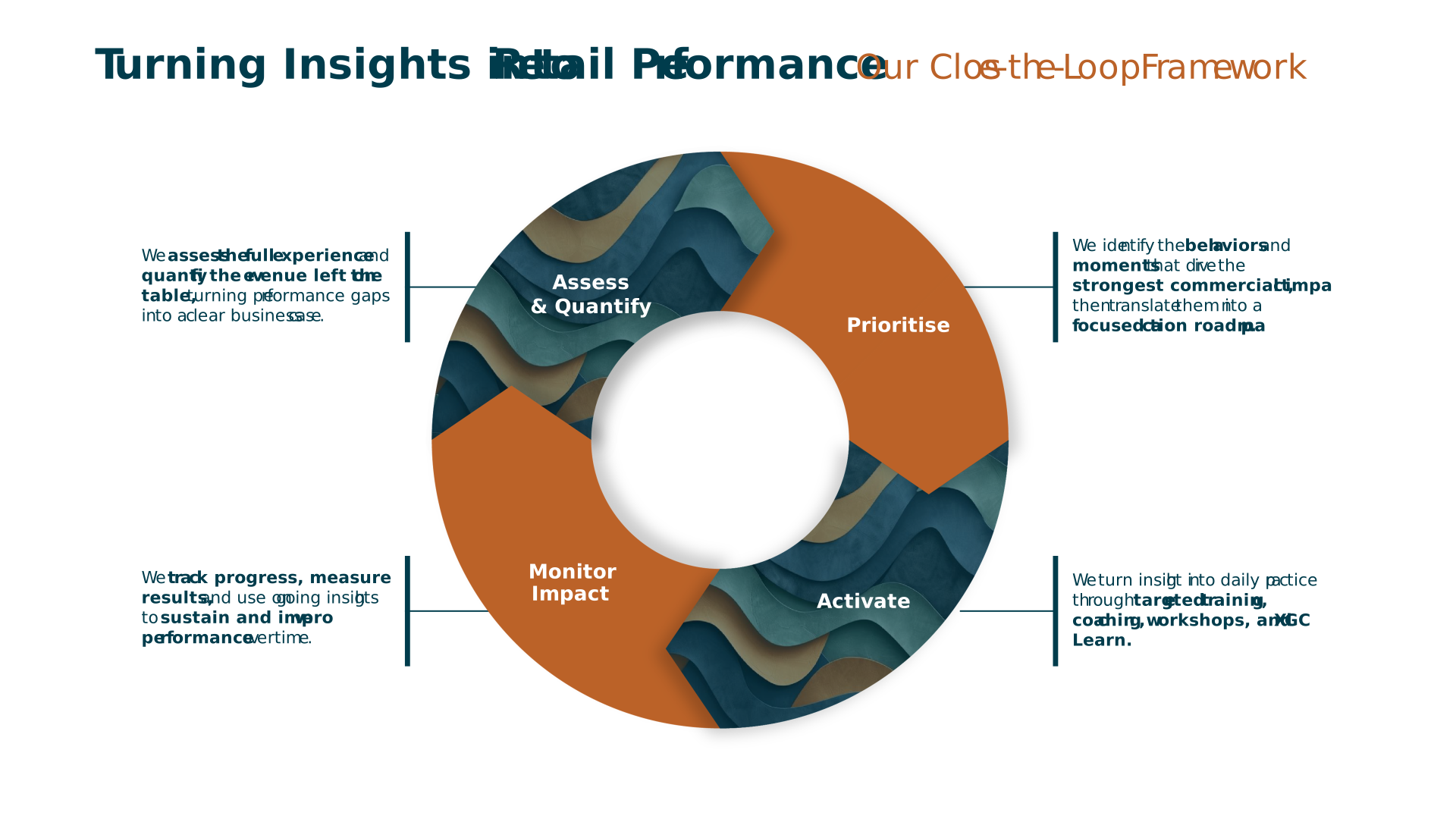
02 | Prioritise Focus & Recommend
Assessment produces findings. Prioritisation produces direction. Not every behavior matters equally. A small number of moments produce a disproportionate share of the commercial outcome, and identifying those moments is what distinguishes effort from impact.
The output is a data-driven roadmap with a clear commercial logic: quick wins that generate immediate revenue impact, short-term initiatives that build momentum across the network, and longer-term capability investments that compound performance over time. Central to this roadmap is the recognition that Sales Advisor behavior and mindset are the most direct levers of commercial performance. Small, targeted shifts in how an Advisor opens a conversation, reads a client, introduces a second category, or handles a moment of hesitation can move conversion and basket value measurably and quickly. The roadmap identifies behaviors to prioritize, giving leadership a concrete action plan with a clear line of sight from each initiative to its expected impact on revenue.
03 | Activate Implement Initiatives
This is where insight becomes routine. Activation at scale is not a campaign. It is the construction of new operating habits across thousands of Sales Advisors and hundreds of boutiques, through bespoke training and workshops, targeted coaching, and the CXG Learn platform: CXG’s AI-powered, hybrid learning hub designed to deliver capability at the speed and scale that luxury networks require.
The behaviors that unlock performance must become the behaviors that define daily practice. That transition, from knowing to doing, from event to habit, is the most critical and most frequently underestimated step in retail transformation.
04 | Monitor Impact Track Results & Progress
The loop closes with monitoring: tracking results, measuring performance outcomes, and providing the ongoing end-to-end support that ensures change holds and compounds over time. This is the stage that separates a performance initiative from a performance discipline.
The loop closes when monitoring informs the next assessment. The cycle begins again with sharper focus, greater precision, and a clearer picture of what is working and why. This is the operational architecture behind Retail Performance at Scale.
The Discipline of Scale
Why Scale Is the Differentiator
Lifting performance in a single boutique is not, in itself, a strategic challenge. A skilled manager, a focused initiative, a few quarters of attention, and the curve will move. Luxury retail has produced thousands of examples of individual boutiques transformed by individual leadership.
The harder and more valuable question is whether the same lift can be achieved consistently, across hundreds of boutiques, dozens of markets, multiple categories, and thousands of Sales Advisors, while protecting the cultural and brand integrity that makes luxury what it is.
This is the discipline of scale, and it is qualitatively different from the discipline of single-site improvement. At scale, the work becomes systemic. It requires shared measurement, behavioural standards that are precise enough to be actionable and flexible enough to be culturally adapted, prioritisation logic that sequences the highest-impact behaviours, and an activation cadence that turns insight into routine.

Strategic Clarity
The Three Questions Defining the Next Decade
Every retail leader operating at scale benefits from being able to answer three questions, not as intuitions, but as quantified, actionable positions.
1. What is the performance opportunity in our network today?
Not as a sense of direction, but as a figure: the measurable distance between current and optimal performance. Without it, the conversation about retail remains aspirational rather than operational.
2. Which behaviours unlock that opportunity fastest?
In every network, a small number of in-store behaviours produce a disproportionate share of commercial outcomes. The discipline is in identifying them precisely, and sequencing them ahead of the dozens of others competing for management attention.
3. How do we activate change across markets while protecting brand integrity?
The answer is not uniform standards imposed globally. It is a shared performance discipline that adapts to cultural context while honouring the identity that makes the brand worth visiting in the first place.
The Decade Ahead
The Work That Defines What Comes Next
Luxury has spent a decade building an extraordinary physical presence. The doors are open, the locations are claimed, the architectural statements have been made. What happens next will be defined by what brands recover: the existing performance potential, quantified, prioritised, and activated.
This is the work. It is operational rather than theoretical. It is measured in conversion, units per transaction, and average basket, alongside the customer experience metrics that have always sat at the heart of luxury. And it is delivered not in one boutique at a time, but across the full network, with the consistency that scale demands.
Retail Performance at Scale is the discipline this decade calls for. The brands that adopt it will define the category, and the customer experience teams, retail leaders, and Sales Advisors who deliver it will be the architects of luxury’s next chapter.