Are Your Frontline Teams Truly Set-Up for Success?
Frontline Readiness Reveals Whether Your Teams Feel Equipped, Enabled, and Supported to Deliver Optimal Retail Performance


Luxury has built an increasingly precise picture of the customer: how they move through the journey, what moments shape their satisfaction, where expectations are met and where they fall short. Journey mapping, satisfaction tracking, and evaluation visits have matured into a genuine science of the customer’s side of the counter.
Far less scrutiny has gone to the other side of it. Every one of those carefully designed experiences still depends on someone to deliver it: the Sales Advisor executing the brand’s playbook, the team lead translating strategy into daily coaching, the store director holding it all together under commercial pressure. Some brands have largely assumed their frontline is ready to bring that experience to life; an assumption that is rarely put to the test.
At CXG, we built Frontline Readiness to test it.
The Missing Variable
Why Frontline Readiness Now?
Retail performance has traditionally been explained by three variables: traffic, product desirability, and brand equity. Each remains real. None is sufficient on its own. A customer can walk into a boutique carrying real intent, drawn by a desirable product and a brand she already trusts, and still leave without having been served the experience the brand believes it delivers. The reason is rarely the traffic, the product, or the brand. It is what happened, or failed to happen, in the interaction itself.
That interaction is carried by a person, and that person’s ability to deliver it depends on conditions that sit upstream of the customer encounter entirely: whether she is clear on what is expected of her, whether her training gave her something she could actually use on the floor, whether her manager coaches her or simply supervises her, whether the tools and processes around her help or slow her down. These conditions are not cosmetic. They are the infrastructure that determines whether a beautifully designed customer experience survives contact with a real shift, a real queue, a real Tuesday afternoon.
This is the missing variable in most retail performance conversations happening today.
Brands have built extraordinary frameworks for what the customer experience should be. What they have not systematically measured is whether the frontline is equipped, enabled, and supported to deliver it. Frontline Readiness closes that gap.
Beyond Employee Listening
A Different Kind of Diagnostic
Frontline Readiness is easy to mistake for something the industry already has. Employee engagement surveys are well established in luxury retail. Voice of the Team programmes are common. It would be reasonable to assume Frontline Readiness is another entry in that category.
It is not, and the distinction matters. Engagement and satisfaction surveys ask how people feel about their employer. They are valuable, but they are oriented toward sentiment rather than execution, and sentiment does not translate cleanly into commercial outcome. A team can report high engagement and still struggle to activate clienteling behaviours, because engagement was never the variable standing between the brand’s intent and the customer’s experience.
Frontline Readiness asks a more business-led question. Not how do you feel about working here, but do you feel equipped, enabled, and supported to deliver what is expected of you in front of a customer. It connects team feedback directly to execution, customer experience, commercial performance, leadership support, training, tools, and the operational realities of the shop floor. It is a retail performance diagnostic that happens to be delivered through the voice of the team, rather than an employee sentiment survey that happens to touch on performance.
Where The Gap Lives
The Four Conditions That Shape the Shop Floor
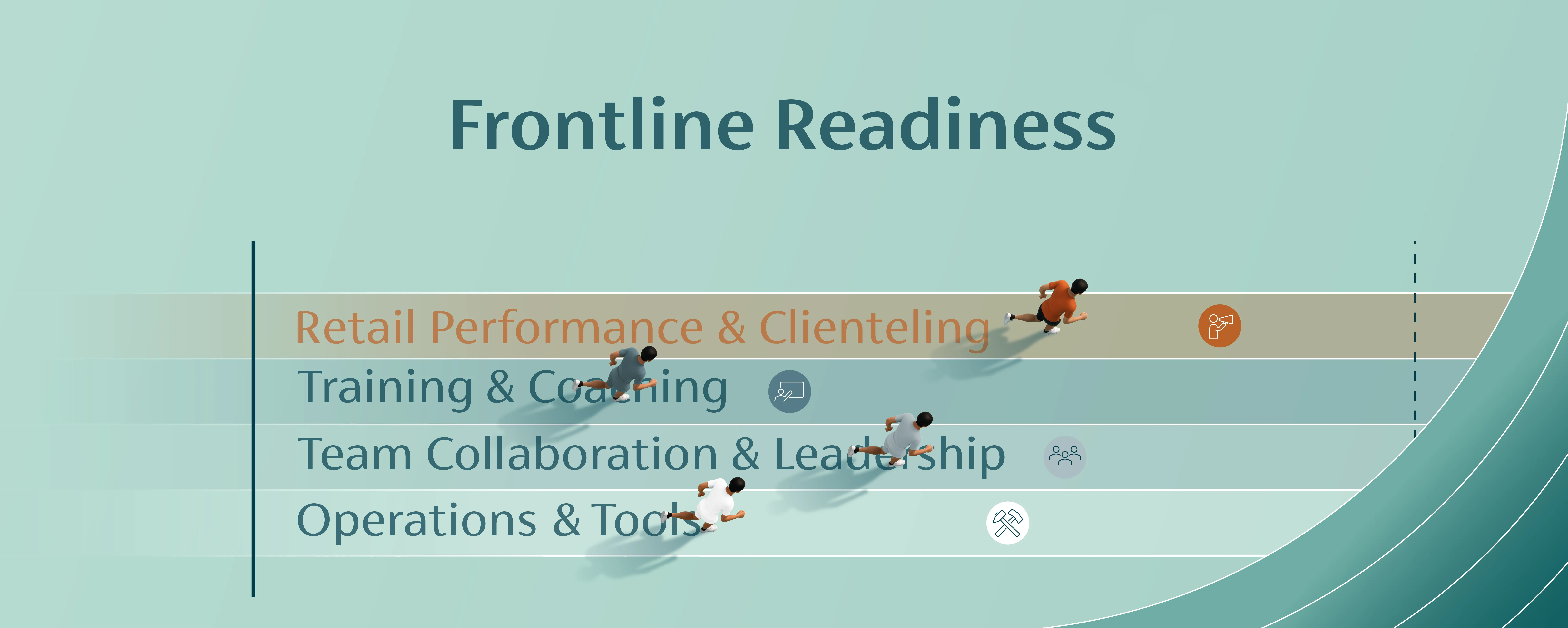
When a brand asks why performance is not progressing as expected, why customer experience scores have plateaued, or why teams struggle to activate the clienteling behaviours leadership has asked for, the answer typically lives in one of four places.
It lives in Retail Performance and Clienteling: whether teams are actually clear on their KPIs, on what is commercially expected of them, and on the behaviours that are supposed to drive stronger results. Clarity here is assumed far more often than it is confirmed.
It lives in Training and Coaching: whether the training teams receive genuinely builds confidence and translates into skills they can apply in front of a customer, or whether it remains a well-produced module that never survives the walk from the classroom to the floor.
It lives in Team Collaboration and Leadership: whether the daily rituals, management routines, and team dynamics around an Advisor build alignment and motivation or quietly erode them.
And it lives in Operations and Tools: the processes, systems, and everyday frictions that either clear the path for performance or stand in its way, often invisibly, until someone finally asks the team directly.
Individually, these four conditions rarely appear in a boardroom deck. A conversion rate is visible. The reason a specific team is underperforming against it usually is not, because it sits below the level at which most reporting operates.
Frontline Readiness is built to surface exactly that layer: the conditions between the dashboard and the outcome.
Our Methodology
From Diagnosis to Action
Frontline Readiness is built as a flexible, modular programme, adaptable to a brand’s context, market priorities, and business objectives. It operates across three connected stages.
01 | Assess Measuring Readiness
It begins with an anonymous, mobile-friendly survey built specifically for frontline teams, typically completed in ten to twelve minutes. The questionnaire combines universal, benchmarkable questions with project-specific diagnostics adapted to the brand’s context, markets, and current business challenges. This first step quantifies where teams feel equipped, enabled, and supported, and where readiness gaps may be limiting commercial performance and customer experience. Results are analysed at an aggregated level, with subgroup analysis reserved for samples large enough to protect respondent confidentiality.
02 | Learn Uncovering Root Causes
Assessment identifies where readiness is weakest. It does not, on its own, explain why. For that, CXG facilitates targeted focus groups with selected frontline participants, in English or in local languages, designed to go deeper into the lowest-readiness areas. These sessions surface the practical barriers behind the numbers, the best practices already emerging informally on the floor, and the improvement opportunities a survey alone cannot reach. They also do something a survey cannot: they show teams they are part of the solution, not simply the subject of it.
03 | Design Activating Performance Improvements
CXG consolidates the findings into clear recommendations and action priorities. Depending on the root causes identified, this can take the form of results presentations, action-planning workshops, behavioural activation, capability-building, leadership enablement, or roadmap design, helping cross-functional teams translate insight into sustainable performance improvement rather than a one-time report.
The Mirror Effect
What Happens When Two Truths Meet
Frontline Readiness becomes more powerful when connected to CXG’s customer experience data. The result is a mirror analysis: what our Evaluators experience as a customer, set directly against what frontline teams believe is happening on the ground.
The value of this comparison is in the gaps it exposes. A team can report strong confidence in its clienteling behaviours while customer evaluations tell a different story, and that distance is itself a finding: a signal that the gap is not one of intent, but of translation between what teams believe they deliver and what customers actually receive. Equally, a team can report low confidence in an area where customer experience data shows the brand is already performing well, revealing a coaching or recognition gap rather than an execution gap.
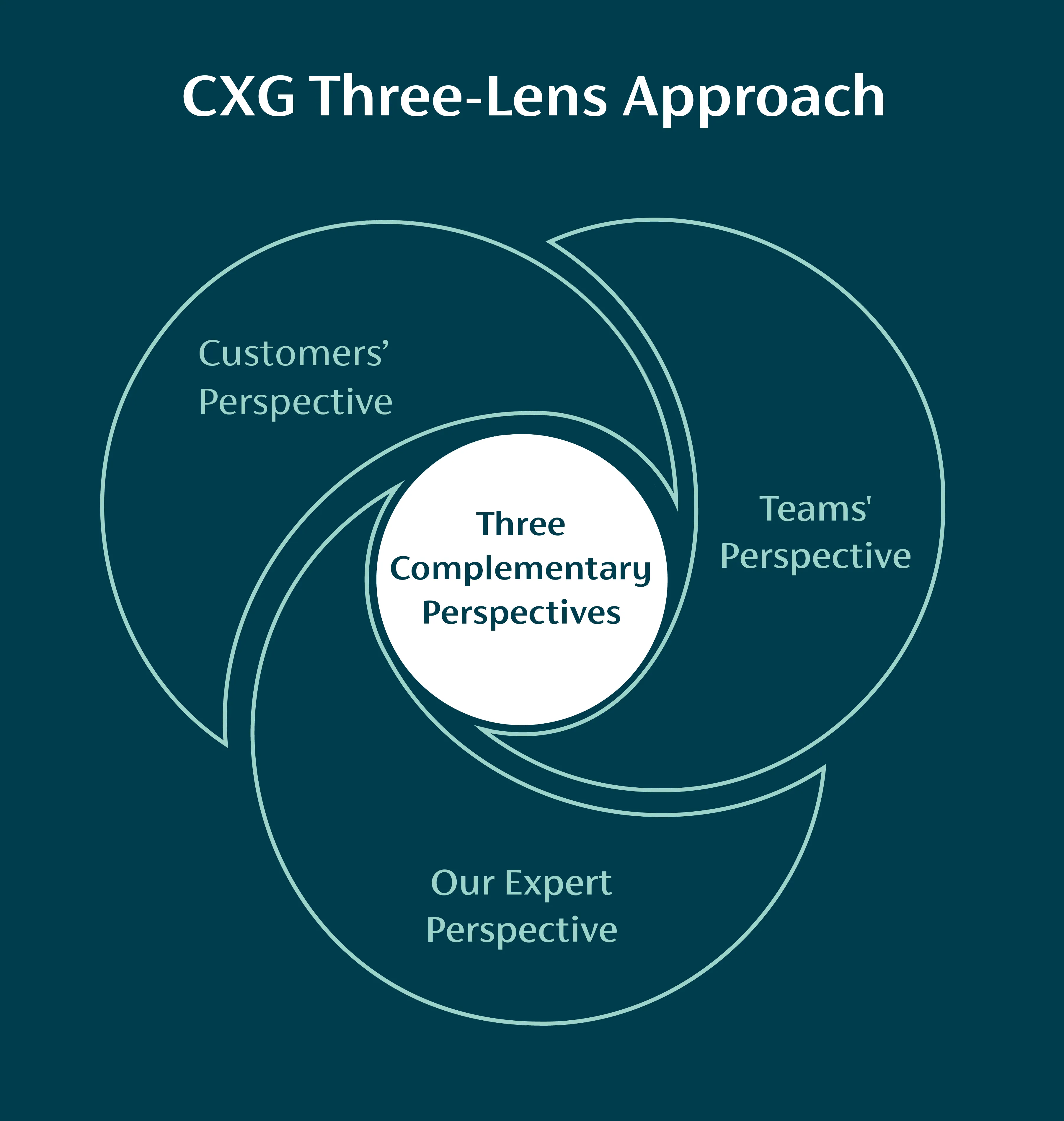
This gives leadership something rarer than a single data source: a complete view of the retail ecosystem, bringing together the voice of the customer, the voice of the frontline, and CXG’s own expert perspective, in one picture.
Strategic Clarity
The Questions Every Retail Leader Should Be Able to Answer
1. Are our teams actually equipped to deliver what we expect of them? Not as a general sense of morale, but as a quantified view of where teams feel clear, confident, and supported, and where they do not. Without it, capability investment is a guess dressed up as a strategy.
2. Where, specifically, do the readiness gaps sit? Across clienteling clarity, training and coaching, leadership and collaboration, or operations and tools, a small number of root causes typically explain a disproportionate share of the performance gap. Naming them precisely is what turns a broad sense of underperformance into a short list of things worth fixing first.
3. How do we turn diagnosis into a habit rather than a one-time report? The answer is not a survey filed away after a results presentation. It is a closed loop: assessment, root-cause understanding, activation, and remeasurement, repeated on a cadence that keeps pace with how quickly conditions on the floor actually change.
The Decade Ahead
The Work That Defines What Comes Next
Luxury has spent a decade refining what the customer is meant to experience. Frontline Readiness starts from a different, and in many ways more consequential, question: whether the people responsible for delivering that experience have been given what they need to do it.
The answer is rarely a simple yes or no. It is usually a specific, addressable set of conditions, some visible to leadership and most not, sitting quietly between a well-designed customer experience strategy and its execution in a real store. Frontline Readiness exists to make those conditions visible, to prioritise them, and to help brands act on them before they show up as a conversion rate no one can quite explain.
This is not a replacement for the work luxury has already done on customer experience. It is the missing half of it. The brands that pair a clear view of the customer with an equally clear view of the frontline will be the ones whose experience strategies actually survive the floor, and the customer experience leaders, retail leaders, and store teams who close that loop will be the ones who define what execution looks like for the next decade.