Dressed for the Beautiful Game
How Brands are Leveraging the Power of Feeling and Belonging at the 2026 FIFA World Cup


The best campaigns don’t sell products. They tell stories that make you feel something powerful before you realise a brand is involved.
This is the quiet genius behind the most interesting brand work at the 2026 World Cup. From heritage luxury houses to global sportswear names, the brands getting it right haven’t shown up with billboards and broadcast slots. They’ve arrived with something more valuable: a more heartfelt understanding of what football means to people. Not football as spectacle, not football as lifestyle signifier, but football as the as the emotion felt in your chest that makes moves you to tears when the anthem plays. There are many campaigns vying for attention this summer, and the examples below weave a cohesive web of emotive storytelling.
The Love of the Game
What these brands have are viscerally touching upon, and what makes their campaigns work is that football is one of the most emotionally charged experiences on earth. The love of the game runs deeper than any product, any logo, any campaign. It runs deep in your veins. It is passed down through families, sung in stadiums, felt in living rooms at eleven o’clock on a Tuesday night.
Burberry, Adidas, Nike, and Jacquemus are each tapping into that feeling from a different angle. Burberry goes to England’s terraces and the particular warmth of English fandom. Adidas reaches back to where every football story begins, the backyard, the local pitch, the game when it’s played just for fun. Nike asks what happens when the world’s greatest players stop following instructions. Jacquemus starts with a personal memory and finds a national one inside it.
Belonging: Burberry and the Spirit of Being a Good Sport
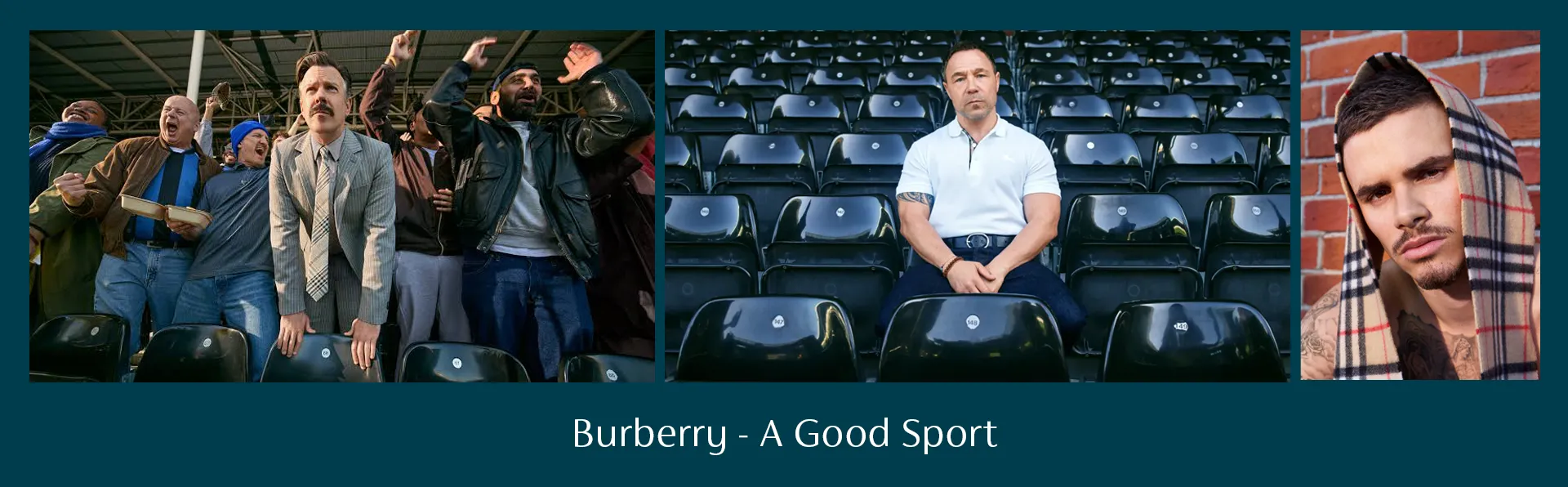
Burberry’s Good Sport campaign makes a choice in its very first frame that tells you everything about its intentions: it moves away from the pitch and into the stands.
Rather than staging football as spectacle, the campaign is interested in what surrounds it; the gathering, the waiting, the people you find yourself standing next to. Brand ambassador Bright appears in the stands alongside Jason Sudeikis, a tongue-in-cheek nod to the success of the show Ted Lasso, which did a lot to bring soccer into the collective consciousness of TV viewers in the US, and Romeo Beckham. Jodie Turner-Smith moves through the pre-match rush. England players Eberechi Eze, Declan Rice and Leah Williamson are there, but not as untouchable icons. Stephen Graham plays a youth coach. Lucy Punch and Rosie Huntington-Whiteley cheer from the sidelines. These are “regular” people at the match, not faces arranged for glamour.
Daniel Lee, Burberry’s Chief Creative Officer, frames it simply: “There’s a certain attitude to being a good sport that is very British and very Burberry.” That phrase names something that doesn’t really have an official name, the particular English genius for showing up regardless of the result.
Playing Free: Adidas and the Myth of the Backyard
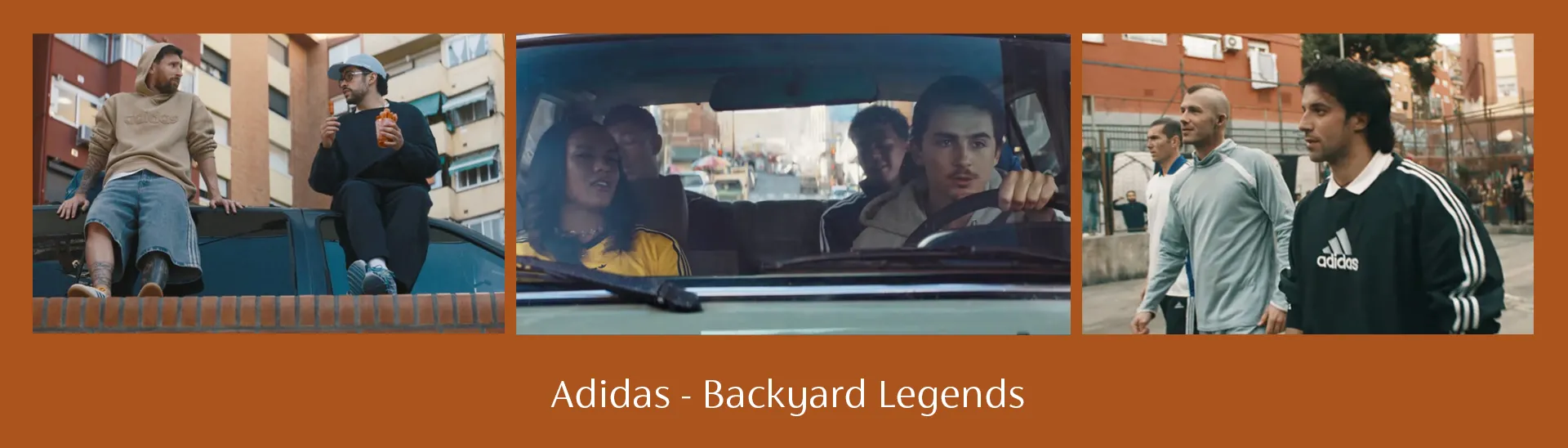
Reports suggest Backyard Legends cost approximately £50 million to produce. Considering the star-studded cast this is not at all surprising.
The five-minute film centers on a neighborhood pitch ruled by an unbeaten local crew for thirty years, and Timothée Chalamet’s attempt to assemble a team capable of taking them on. That team comprising Jude Bellingham, Lamine Yamal, and Trinity Rodman, with sideline appearances by Lionel Messi, and Bad Bunny, faces a legend so stubborn it once saw off Zidane, Beckham and Del Piero (also featured as their younger selves). Set against a 90s aesthetic of terrace style and analogue textures, the film is part football story, part cultural time capsule.
As Official Match Ball provider and kit supplier to 14 federations, Adidas is already everywhere at this tournament. Backyard Legends is the brand making a case for something beyond that infrastructure, the idea, carried through the You Got This campaign, that the game belongs to anyone with a ball and a patch of ground. It’s an idea with a truly democratic appeal.
Off Script: Nike and the Football That Can’t Be Coached
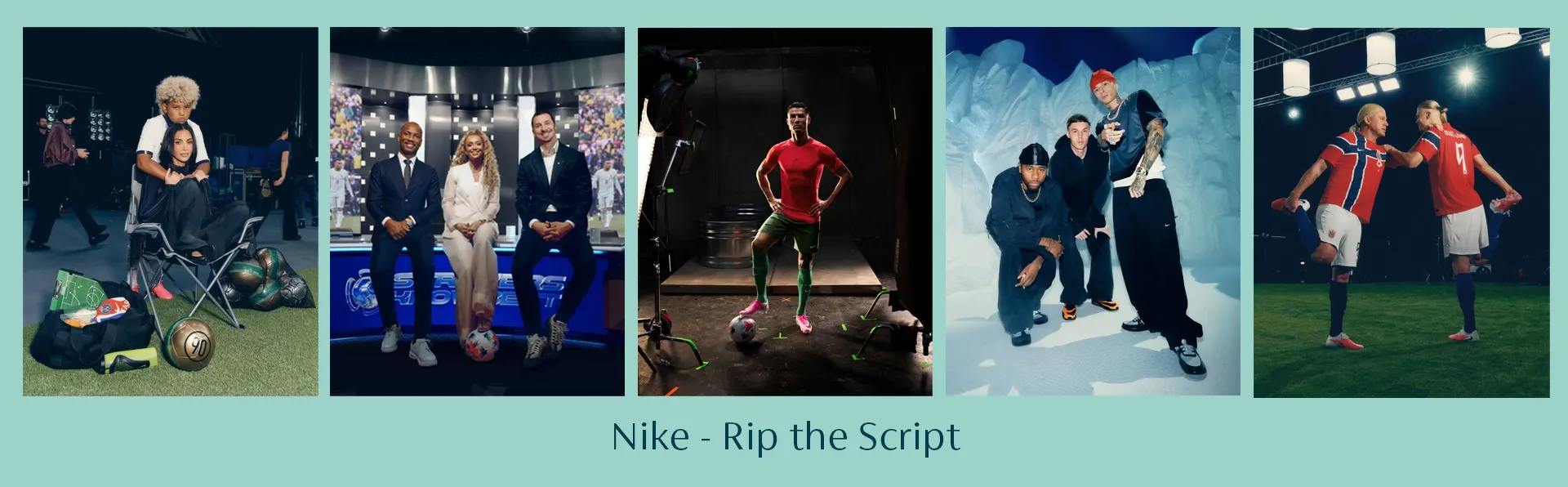
Where Adidas romanticises the backyard, Nike goes to Hollywood, literally. Rip the Script is set inside a mega-studio where past and present collide, footballers ignore direction, and chaos is the point.
The concept is straightforward: the best moments in football happen when players stop thinking and start trusting. The film brings together an enormous cast, with current players including Ronaldo, Mbappé, Haaland, Vini Jr., Cole Palmer, Jamal Musiala, Alexia Putellas, and Nico Williams, alongside legends Cantona, Ronaldinho, Zlatan, Drogba, and Jorge Campos, who are still playing by their own rules even in retirement. Cultural figures, LeBron James, Travis Scott, Kim Kardashian, Channing Tatum, and Central Cee among them, watch the unfolding chaos with visible amusement. Six youth players from Toma el Juego, Nike’s community street football program, round out a cast that spans generations, continents and disciplines.
The film runs just over six minutes, but Nike’s ambition extends further than a single release. Rip the Script is framed as a doorway to an “unfolding universe” of Nike Football content: layered, ongoing, Easter egg-packed, with subplots and extensions designed to keep fans and creators discovering new threads throughout the summer. The instinct behind it reflects where the attention economy actually is: meeting football culture across entertainment, music, and social media, rather than expecting audiences to arrive at a single central piece of content.
Memory and Pride: Jacquemus, Nike and the French Feeling
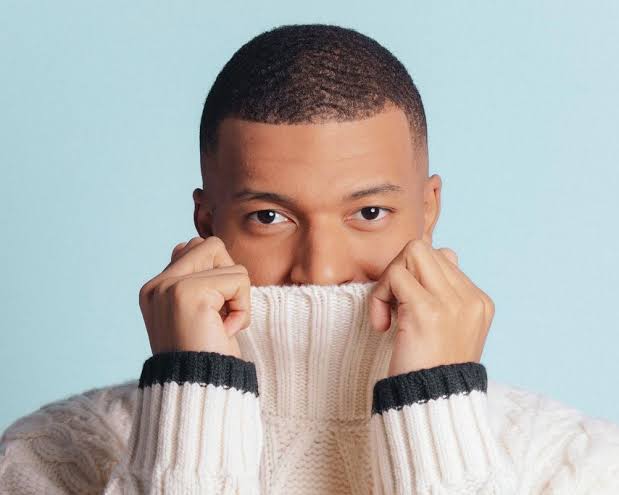
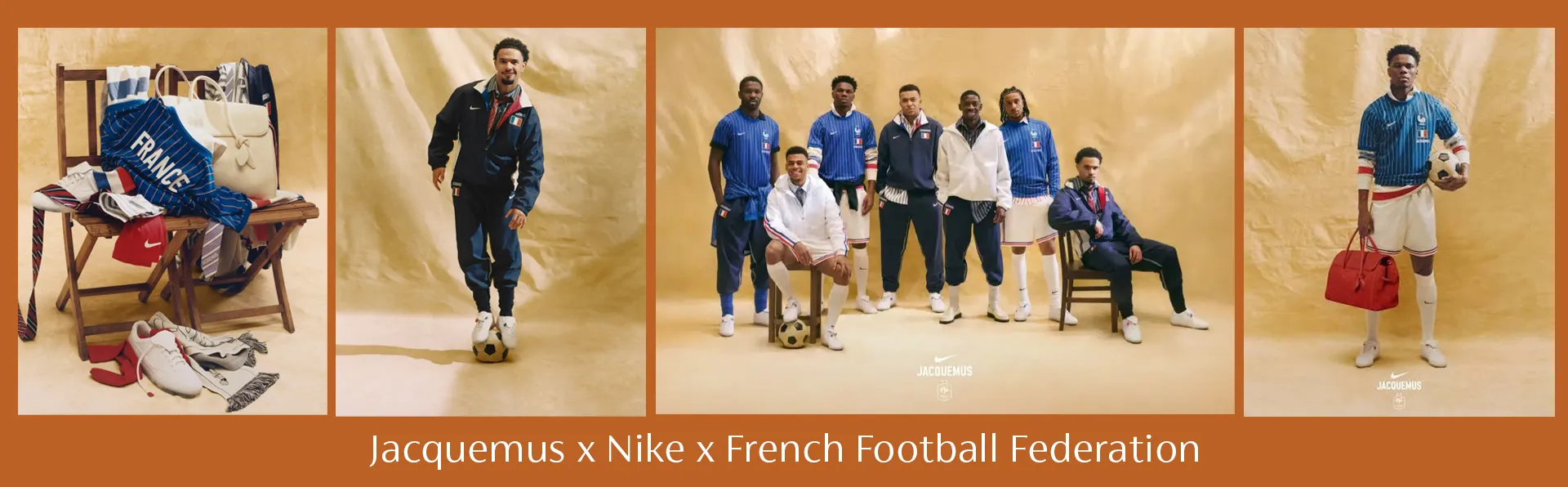
Every design decision has an origin. For Simon Porte Jacquemus, this collection traces back to a vintage navy Nike tracksuit jacket worn in his youth, the kind of thing you don’t think about at the time and can’t stop thinking about later.
That memory sits at the heart of the Jacquemus x Nike x French Football Federation collaboration, and it gives the whole project a personal texture that lifts it beyond a straightforward commercial deal. The collection draws on nineties French football culture, which in France carries a very specific weight, pointing back to 1998, to a home World Cup victory that felt like a statement about the country as much as its football team. Jacquemus grew up inside that era. The collection reflects it: clean lines, blue, white and red, classic fabrics in place of technical materials, clothes that feel honest rather than engineered.
The campaign itself is minimal, a 40-second film featuring Mbappé, Thuram, Tchouameni, Zaire-Emery and Doué. The story isn’t in the video. It’s in the concept behind it.
The Story Is the Feeling
None of these campaigns lead with the product. Burberry leverages the sense of community in English football fandom. Adidas leads with a memory, the backyard, the kickabout, the game played purely for joy. Jacquemus leads with a personal origin story that opens into something national. Nike asks what football looks like when you strip away the instructions.
Football is one of the last spaces where collective feeling operates at full volume, where millions of people experience the same moment simultaneously.
Every brand approaches their World Cup campaign from a singular vantage point that fits their unique heritage, emotional blueprint and DNA. But the ones truly resonant with worldwide audiences are tapping into a sense of profound belonging, a genuine love of the game, and a feeling of being part of something much larger than oneself. Ultimately, they understand that the universal joy of the beautiful game unites foes and friends alike and serves to bring people together.